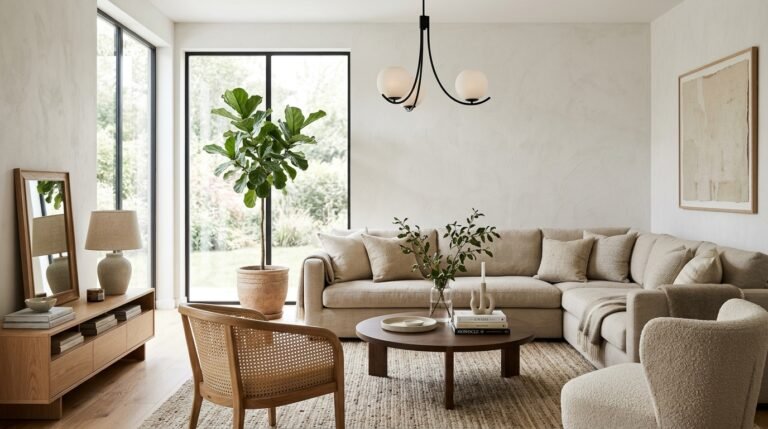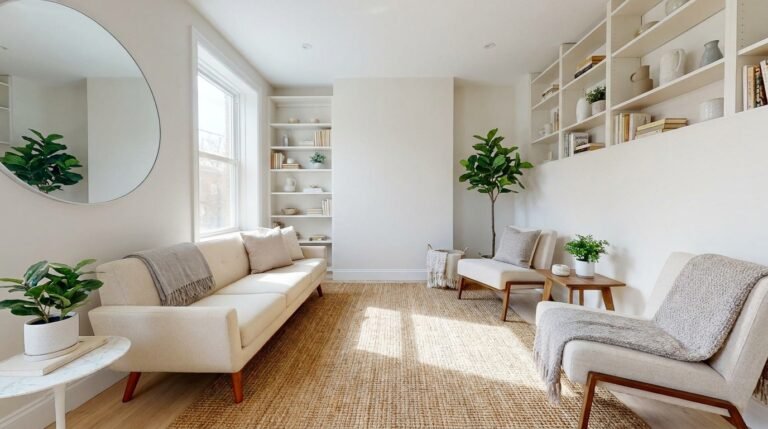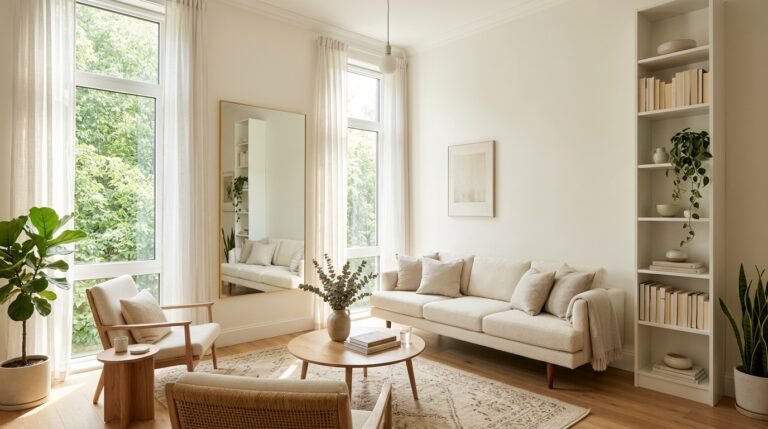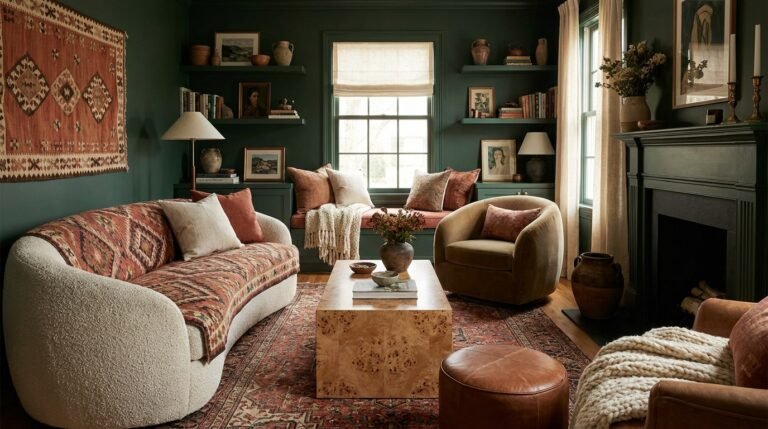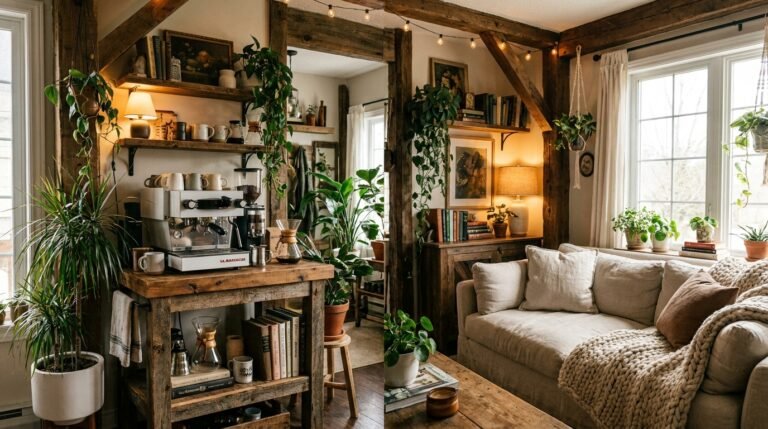

Effortless Ways to Elevate Your Home Decor on a Budget
Rooms rarely look cheap because of what they cost. They look cheap because of a handful of specific tells, and most of those tells are free to remove.
Visible packaging, shiny synthetic fabric, a single overhead bulb, a print in a thin plastic frame. None of that is about budget. It is about details that quietly announce themselves.
The twelve sections below name the tell in each area and the fix for it. Several cost nothing at all, and the rest cost very little. Learning to elevate your home decor is largely a matter of learning what to remove.
Declutter for an Instant Refresh

Branding is the loudest cheap-tell in most homes. Bottles, boxes, and packaging carry logos and bright label colours that no styling can compete with.
Decanting fixes it for almost nothing. Washing-up liquid goes into a plain bottle, dry goods into glass jars. That removes a dozen competing designs from a kitchen in one afternoon.
Cables belong in the same category. Chargers trailing across surfaces read as clutter in an otherwise tidy room. A few adhesive clips clear them out of sight.
Rearrange What You Already Own

Furniture arranged in a ring around the walls is the tell here. It leaves an empty patch in the middle and makes the room read as a waiting area.
Pulling pieces inward creates a group instead. Even a few centimetres off the wall changes the impression, because the arrangement then looks chosen rather than defaulted to.
The doorway view is the one that matters. Standing at the entrance shows what visitors see first, and rearranging to suit that angle costs nothing but an afternoon.
Add Greenery Throughout

Two things give faux plants away, and neither is the leaf. The moulded plastic disc pretending to be soil is the first. Uniform, evenly spaced stems are the second.
Both have cheap fixes. Real soil, moss, or pebbles over the base hide the disc entirely. Bending a few stems out of alignment breaks the factory symmetry.
A struggling real plant reads worse than no plant. Leggy stems and brown tips draw the eye. A plant that is not thriving belongs somewhere with better light, not on display.
Switch Up Your Throw Pillows

Sheen is the giveaway with cushions. Shiny polyester satin catches light in a hard, plasticky way that no amount of arranging disguises.
Matte surfaces read expensive at any price. Cotton, linen, and brushed weaves absorb light instead of bouncing it. A cheap linen-look cover therefore outperforms a costlier shiny one.
Zip placement is the free detail. Turning every zip to face downward and toward the back removes a row of visible hardware across the sofa.
Layer in Cozy Textures

Synthetic and natural fibres fold differently, and that difference shows across a room. Polyester holds stiff, springy folds. Cotton, wool, and linen fall in soft ones.
Draping beats folding. A throw folded into a crisp rectangle reads as a display. One thrown over an arm and left to settle reads as a home.
Creases from packaging are the other free win. New textiles arrive with hard fold lines. Steaming, or a damp cloth and a warm iron, removes the clearest sign that something came out of a plastic bag.
Update Your Lighting

A bare bulb overhead is the most recognisable tell of all. It casts light straight down, flattens every surface, and puts hard shadows under everything.
Shade lining then does more than most people realise. A cream or gold-lined shade throws warm light outward. A white lining stays neutral, and a dark lining sends light up and down instead of into the room.
Proportion finishes the job. A shade should sit roughly two thirds the width of its base and cover the fitting completely. A mismatched pair shows from across the room.
Add Affordable Wall Art

Mount width does more for a cheap print than the print itself does. A narrow border reads as mass-market. A generous one, several centimetres deep, reads as gallery framing.
That means the sensible spend is the frame rather than the artwork. A modest print in a wide mount and plain wooden frame wins every time. An expensive print in thin plastic does not.
Frames also come apart. Buying a larger secondhand frame and cutting a new mount to fit is one of the cheapest upgrades available. This guide to beautiful home decor ideas covers hanging heights and fixings.
Use Mirrors to Add Light

Cheap mirror glass distorts, and the test takes two seconds. Looking at a straight line in the reflection, such as a door frame, reveals any waviness immediately.
Fixings are the second tell. Metal clips holding a frameless mirror announce a builder’s fitting. A frame or a concealed hanger does not.
Secondhand mirrors solve both problems cheaply. Older glass often beats modern budget equivalents for quality. A dated frame also takes paint readily.
Style Your Surfaces Thoughtfully

Modern dust jackets are a surprising cheap-tell. Glossy covers with large type and publisher branding turn a bookshelf into a row of advertisements.
Removing them costs nothing and reveals the cloth or board underneath. That is usually a plain, muted colour with small spine lettering. The shelf calms down instantly.
Everything facing forward is the other giveaway. Turning a few objects at an angle removes the shop-display effect that perfect alignment creates. More on arrangement appears in this guide to styling a shelf like an interior designer.
Refresh With Affordable Textiles

Curtains that stop above the floor are the clearest tell in any room. The gap makes the window look shrunken and the fabric look borrowed from somewhere else.
Hemming tape solves it without a sewing machine. Buying the longer length and shortening it with iron-on tape costs a few pounds and takes an evening.
Rugs benefit from the same attention. A budget rug flattened by shipping recovers with steam. A pad underneath stops the curling corners that make it look cheaper still.
Add Candles and Finishing Touches

Untouched candles with pristine white wicks read as props. A candle burned once, with a slightly darkened wick, reads as something someone actually uses.
That first burn matters practically too. Wax needs to melt all the way to the edge on the first lighting. Otherwise the candle tunnels down the middle and wastes most of itself.
Fresh stems beat elaborate arrangements on a budget. Three branches from a garden in a plain vase look considered. A dusty artificial arrangement is among the most reliable cheap-tells there is.
Repurpose and Upcycle

Preparation separates a good upcycle from an obvious one. Clean with sugar soap, key the surface lightly with sandpaper, then prime. Those three steps stop paint chipping off within months.
Older painted furniture needs a safety check first. The CDC dates the ban on lead-based paints for residential use to 1978. It also warns that common activities such as sanding create hazardous lead dust. Anything painted before then is worth testing with an inexpensive kit rather than sanding blind.
Where lead turns up, painting over rather than sanding is the safer route. Cleaning the surface and sealing it leaves the old layers undisturbed, which is what keeps the dust where it belongs.
Final Thoughts
Almost nothing above is a purchase. Decanting, hiding cables, turning zips, steaming creases, removing dust jackets, burning a candle once. All free, and all removing something rather than adding it.
The small spends follow the same logic. Hemming tape, a rug pad, a wide mount, a warm bulb. Each one corrects a specific tell rather than buying a new look wholesale.
That is the whole method. Anyone hoping to elevate your home decor cheaply should hunt the tells first. Find the four or five details giving the game away, then deal with those.
Frequently Asked Questions
How can I make my home look expensive on a budget?
Remove the tells rather than add features. Packaging and branding, visible cables, shiny synthetic fabric, and a single overhead bulb account for most of it. All four cost nothing or nearly nothing to address.
What is the cheapest way to refresh a room?
Steaming the fold creases out of textiles and turning off the ceiling light in favour of lamps. Both are free. Decanting products into plain containers is the next free step, and it removes a dozen competing designs at once.
Where can I find affordable home decor?
Secondhand, particularly for mirrors and frames. Older mirror glass is frequently better made than budget modern equivalents. A large secondhand frame also re-mounts around a cheap print for a fraction of retail framing.
Do plants really make a home look better?
Healthy ones do. A leggy or browning plant draws attention to itself and reads worse than an empty corner. With faux plants, the moulded plastic base is the giveaway, and covering it with real soil or moss fixes that.
What small changes make the biggest difference?
Curtain length, lamp light instead of overhead light, and matte fabric instead of shiny. Hemming tape handles the first without a sewing machine. The other two need only a bulb and a different cushion cover.